
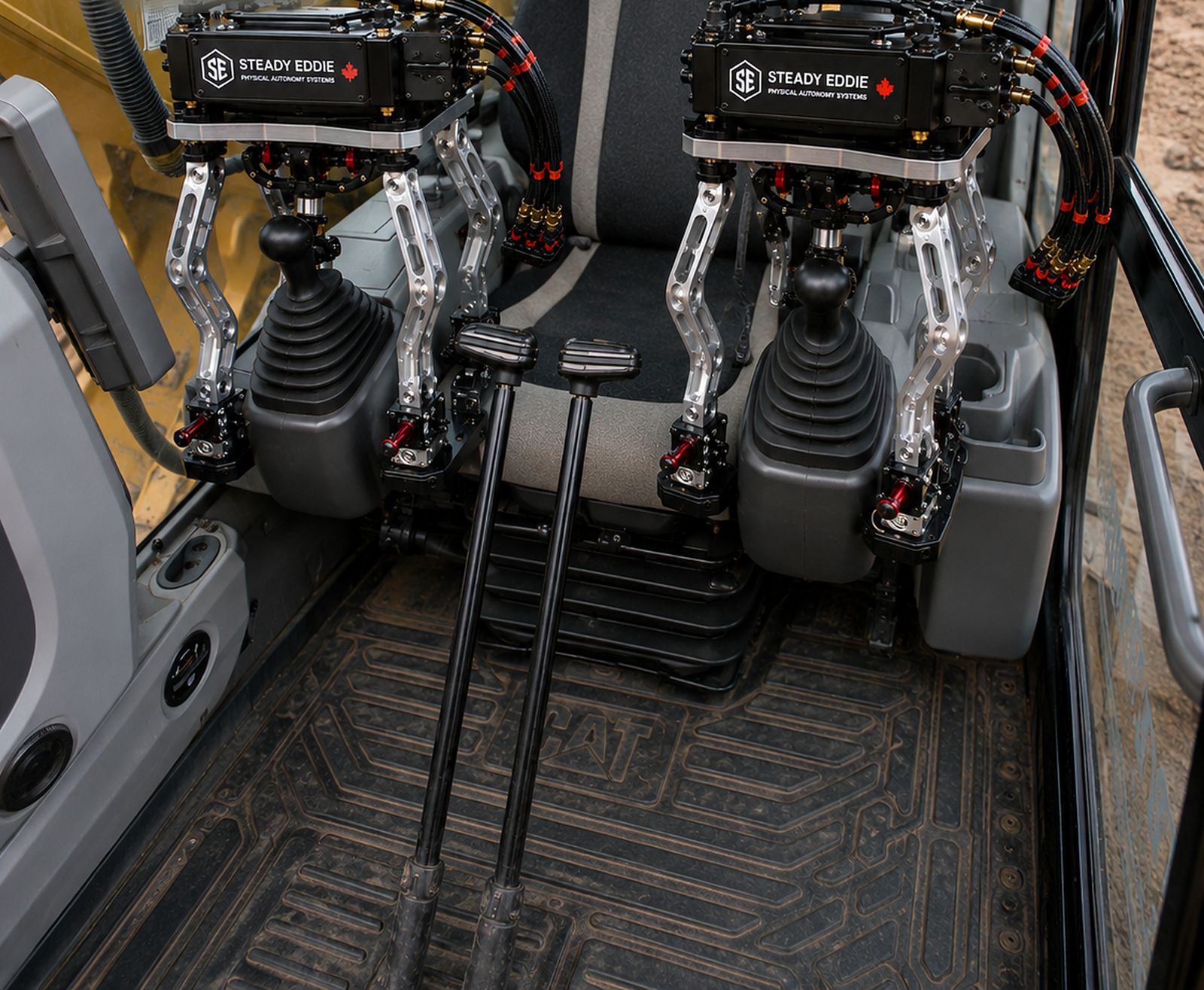
The operator is hardware, and the machine stays stock.
Eddie is a removable robot operator. It sits where your operator sits, works the same controls, and lifts back out when the job is done. Eddie is a helping hand: it works the tools, and it does not decide. It drives and works the machine on the ground the job needs. On civil work a person starts the machine every session; on the defence line it can also be started on a command from a stand-off station, on closed ground with nobody at the machine.
Excavator cab, Steady Eddie on the joysticks.
Nobody has to be in the field.
Eddie fills the seat. It does not need you standing next to it.
The job is cleared before the machine is. A supervisor takes the work through the Site Foreman in the hour before anything is armed: the scope, the ground, the locate ticket, the pre-start on every machine, and the conditions under which the job stops and calls a person. Six gates, each closed by a named person who wrote something down that day. Until all six are closed, nobody can ask for Eddie at all.
That work is done at a laptop, and it is done before the machine moves. When it is done, a person starts the machine and clears it, and from there nobody has to stand in the field for the rest of the shift.
Somebody is still operating it, or watching it. Which one depends on how much authority that machine has been granted for that job, and that is earned one machine and one site at a time. It is not a model you buy and it is not a switch on the box.
| How the machine is working | Eddie does | The person does |
|---|---|---|
| Instrument | Senses and records. Moves nothing. | Runs the machine as they always have, from the seat. |
| Remote | Exactly what the person commands, and nothing else. | Operates the machine, from somewhere else. |
| Assist | Takes individual functions inside the person’s task. | Holds the task. In the seat or somewhere else. |
| Supervised | Runs a job it has been authorized for. | On the loop. Handles what the job did not expect. |
| Auto | Runs a validated repeating job inside a boundary. | Exception supervision. |
| Eddie out | Nothing. The dock is part of the cab. | Everything. |
Remote operation is manual operation with the person somewhere else. Today every Steady Eddie works there. The rungs above it are designed and written down, and each one opens on one machine and one site only when the validation for it exists. The machine can never promote itself, and an operator’s hand on a control drops it back down at once, without anyone’s permission.
What stays in the field is the machine’s own protection, and none of it depends on anybody being there. The zone around the machine is watched by the machine itself and wired to its safety side, so all it can ever do is take authority away. The stop set is wired and local to the machine. Losing a link never starts the machine and never stops it: the machine is left as it was, and it says so. Anyone who is on site can carry a hold that asks the machine to stand down, and that request latches until somebody at the machine clears it.
We were asked for twenty lanyards with twenty kills, and we refused. A stop that travels by radio can be late, jammed, flat or out of range, and the person holding it cannot tell which. What protects a person has to be local to the machine and wired to it.
Where this stands.
One unit is built and cycling on our own machines, and the three ways to take control away by hand are on it; we will demonstrate every one of them for you at our own Test Facility in Alberta. The Site Foreman itself is written and running today. The planner, the perception and every rung above Remote are designed, specified and written down, and that design is what we will put in front of your engineers and your safety people. No assessment against ISO 13849 or ISO 17757, the standards we design against, has been performed. We would rather you read that here than find it out for yourself later.
Two pieces: a dock and a unit.
The dock is fitted once and stays with the machine. It mounts at the operator station, mechanically, into points the manufacturer already provided: no wiring, no connector, no tap. With the unit out, the dock is just part of the cab and the machine works as it always has.
The unit sets into the dock and lifts back out. It carries the computing, the safety controller, the sensing and the drives that move the controls. You buy a dock for each machine and one unit that goes where the work is.
Control the machine where the operator does.
Docked, Eddie runs the machine through the same joysticks, levers, pedals, dials and switches your operators use, over the same travel a hand or a boot gives them. The machine gets the inputs it was built to get, and it behaves the way its manufacturer built it to behave.
Never onto the machine's CAN bus. Never into its ECU. Never its firmware. Eddie's own actuators and safety controller run on wiring of their own, and none of it touches the machine's.
Your machine does not need electronics for this to work. A new excavator and a machine older than the crew running it are handled the same way. On STE Integrate that means electric where it turns and pneumatic where it pushes.
You fit it, and Eddie calibrates to it every day.
Fit
You fit it, following our instructions. The dock goes in at the operator station and the control units pin onto the machine's own controls. Every part of it is built to come off again and move to the next machine.
Tell it the machine
You select the machine type in the software. Eddie never puts more force on a control than that kind of machine should see.
Calibrate
Eddie works each control through a set of calibration steps and learns where neutral sits, where the limits are, how much travel there is before the machine answers, and how the control comes back when it is released.
Every day
Worn, sloppy controls are the normal condition on an older machine, and no two are alike. So Eddie calibrates on the machine every day it works, not once at commissioning. Calibrating daily is what makes an old machine workable.
Eddie brings its own eyes.
- Eddie senses with its own cameras, its own lidar and proximity sensing, all carried on the unit. It never uses the machine's sensors or its bus.
- It reads the gauges and warning lights by looking at them, so nothing taps into your machine's electronics.
- Its own safety controller and emergency-stop network sit on Eddie's side of the line. Your machine's safeguards stay in place and keep working.
Built for the ground we work.
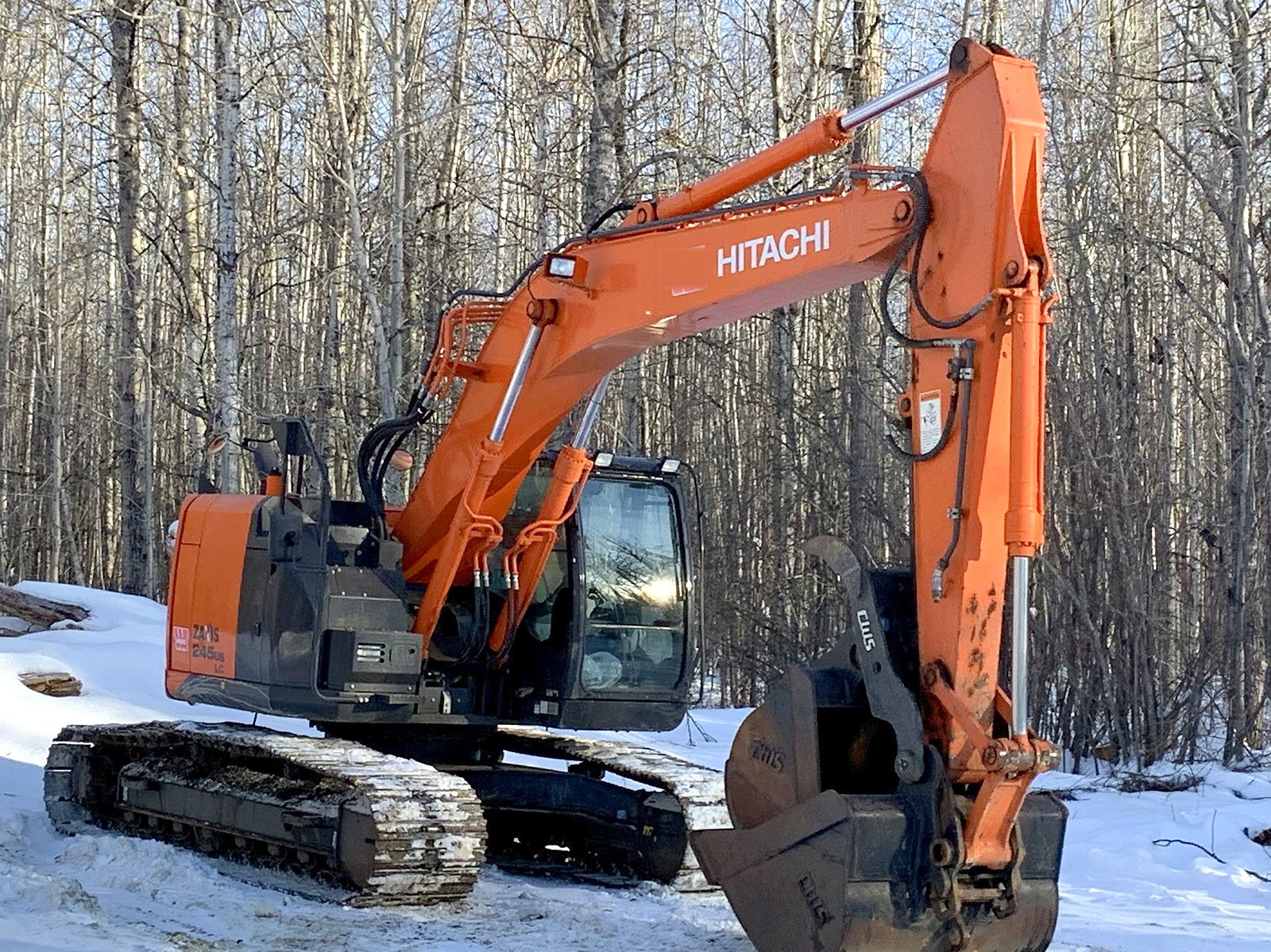
The excavators on a winter right-of-way, Western Canada.
Who is in charge, in order.
- A person starts the machine on civil work.
A person walks around the machine, completes the pre-start inspection, starts it and clears it for operation. Only then does Eddie engage the controls, every session and every machine on that ground. On the defence line the start can come from the stand-off station instead, on closed ground with nobody at the machine, and everything after it is unchanged.
- Rules decide what is allowed.
The planner proposes a move and the rules decide whether it is allowed. Responses are fixed, not improvised.
- The person at the machine is in charge.
Anyone standing at the machine can take Eddie's control away, at any time, with one hand.
- Safety wins, three ways.
Pull the machine's own pilot lockout lever. Pull the red manual release on any actuator, one hand, no tool, no air, no power. Or vent the air, which releases every drive at once; on STE Precision the safety system cuts power to every drive instead.
Steady Eddie operates a machine through its own controls. Nothing is cut, no harness is tapped, no controller is flashed and no OEM software is touched, so the integration and intellectual-property work that an electronic conversion requires does not arise, and the machine's own safety systems are left in place and operating. That is an engineering property and we can show it to you on the machine. It is not a legal opinion. Whether any particular installation affects a warranty, a conformity assessment or a liability position depends on the machine, the jurisdiction and the contract, and it is a question for your counsel. We will not give you a legal opinion, and you should not accept one from any vendor.